Abruzzo: Gran Sasso and the stone villages
Little Tibet at Campo Imperatore, the castle of Rocca Calascio and the road through the Sagittario gorge to Scanno.
- Distance
- 108 km (67 mi)
- Driving
- 1 h 30 min
- Suggested days
- 3
- Stops
- 5
- Countries
- Italy
- Updated
- August 30, 2026
At a glance: 3-day road trip of about 108 km (67 mi) with 5 stops, from L'Aquila to Scanno. About 1 h 30 min of driving in total.
More road trips in Italy · More road trips from L'Aquila
Route description
L’Aquila, the regional capital, has been largely rebuilt after the 2009 earthquake, and the Basilica of Collemaggio and the Fountain of the 99 Spouts are worth a stop. From here, the road climbs past Assergi into the Gran Sasso massif.
Campo Imperatore is a high, treeless plateau nicknamed Little Tibet, with horses grazing under Corno Grande, the highest peak of the Apennines. The road across it is closed in winter, so check conditions outside summer.
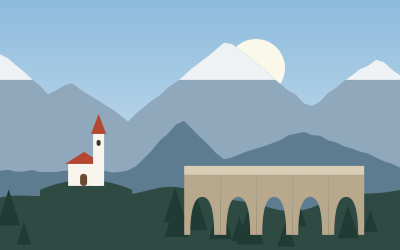
On the southern edge of the plateau, Rocca Calascio is a ruined castle at 1,460 m on a bare ridge of the Gran Sasso, with a tiny octagonal church below it. The stone village of Santo Stefano di Sessanio lies nearby, and the road then descends to Sulmona, a town known for its sugared almonds.
From Sulmona, the road climbs through the narrow Sagittario gorge, past Villalago and Lake Scanno, to Scanno, a stone village where some older women still wear traditional dress. The gorge road is narrow and has tunnels, so drive it carefully in a large motorhome, and watch for livestock on the mountain roads.
Stop-by-stop itinerary
In driving order. Distances are estimates between consecutive stops.
- 1Start
L'Aquila
Italy - 221 km
Campo Imperatore
NatureAssergi, ItalyA high, treeless plateau nicknamed Little Tibet, with horses grazing under the highest peak of the Apennines.
- 321 km
Rocca Calascio
HistoryCalascio, ItalyA ruined castle at 1,460 m on a bare ridge of the Gran Sasso, with a tiny octagonal church below it.
- 446 km
Sulmona
Italy - 521 km
Scanno
Italy
Suggested stages and overnight stops
3 days, split by driving time. Campsites from OpenStreetMap: check opening dates before you go.
- Day 1: L'Aquila → Rocca Calascio · 42 km · 0 h 35 minOn the way: Campo Imperatore.Overnight nearby, for example: Tenuta Il Guerriero - Agricampeggio Capestrano (11 km); L'Oasi di Kilian (19 km).
- Day 2: Rocca Calascio → Sulmona · 46 km · 0 h 38 minOvernight nearby, for example: Agricampeggio Colle dei Lupi (11 km); Camping Orsa Minore (10 km).
- Day 3: Sulmona → Scanno · 21 km · 0 h 17 minOvernight nearby, for example: Area Camper Sant'Andrea (14 km); Camping Sant'Andrea (14 km).
Best time to go
The most pleasant months are usually April–May and September–October. Still fine, with some compromises, in June–August and November. July and August are the busiest months: book campsites early.
Estimate from long-term temperature averages, terrain and pass seasons
Practical notes for the road
- Italy: Motorway tolls. Tolls on most autostrade; pay at the barrier by card or cash. Motorway limit for cars: 130 km/h.
Road rules and fees change. Check official sources before you travel.
FAQs
How long is Abruzzo: Gran Sasso and the stone villages?
3-day road trip of about 108 km (67 mi) with 5 stops, from L'Aquila to Scanno. About 1 h 30 min of driving in total.
How many days do you need for Abruzzo: Gran Sasso and the stone villages?
We suggest 3 days: about 1 h 30 min of driving, which leaves time for the stops.
Where does Abruzzo: Gran Sasso and the stone villages start and end?
It starts in L'Aquila and ends in Scanno.
Which countries does Abruzzo: Gran Sasso and the stone villages pass through?
Italy.
Where can you camp along Abruzzo: Gran Sasso and the stone villages?
OpenStreetMap lists 50 campsites and motorhome stopovers within 20 km of the stops on this route. For example: Agricampeggio Cardito, Tenuta Il Guerriero - Agricampeggio Capestrano and Agricampeggio Colle dei Lupi.
When is the best time for Abruzzo: Gran Sasso and the stone villages?
The most pleasant months are usually April–May and September–October. Still fine, with some compromises, in June–August and November. (Estimate from long-term temperature averages, terrain and pass seasons)